


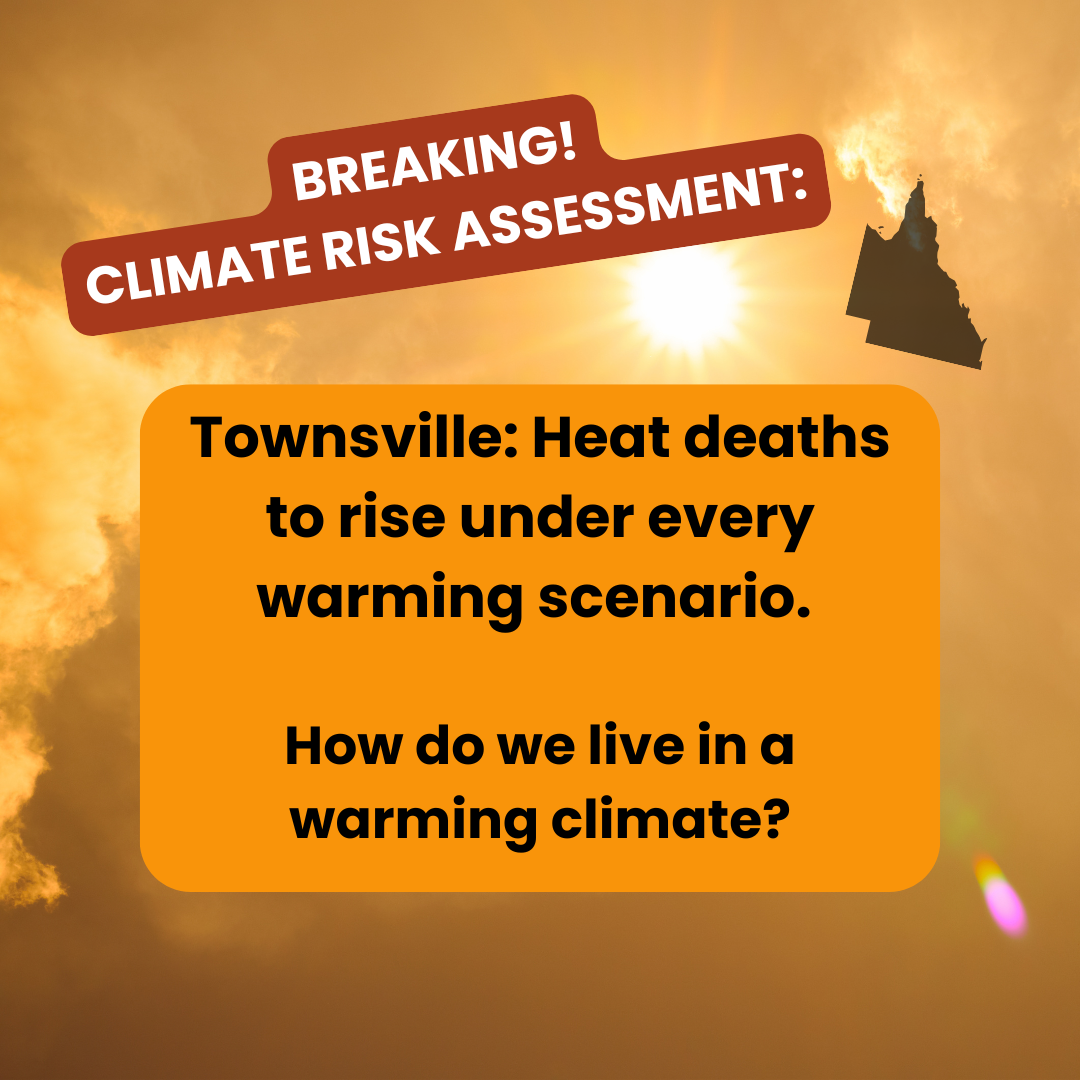
The Australian Government's National Climate Risk Assessment is a dire warning for Australian communities - particularly those of us in the North. A warming climate is set to impact our health services, infrastructure, workforce, schooling, insurance and vulnerable community members. We also know that several endemic species are on the brink, and entire ecosystems are at risk of collapse.
So, what can be done about it?
Limiting global warming to 1.5 degrees or less is becoming more difficult each year. We won't stop pushing for the continued commitment and delivery of a strong climate target in Queensland. However, the time for adaptation is also upon us.
The decisions we make now will decide how liveable North Queensland will be in the years and decades to come.
Following the release of the National Climate Risk Assessment, we drafted an open letter to state and local decision-makers, pulling from local wisdom shared at Sweltering Cities' Townsville Heatwave Workshop and from our own research. This open letter has been signed onto by nine community organisations from across Townsville.
DOWNLOAD AND SHARE THE OPEN LETTER HERE
An Open Letter from Townsville Community Organisations
Addressing Climate Risk in Townsville
To the Honourable Members of the Queensland Parliament and to Townsville City Council,
We, the undersigned community organisations of Townsville, write to you as groups deeply rooted in the wellbeing of our people, our environment, and our shared future. Every day we see the resilience, generosity and ingenuity of North Queenslanders. We also see the mounting pressures of heat, disaster risk and social inequality.
The National Climate Risk Assessment (2025) (NCRA) makes clear that Australia faces urgent and growing threats from extreme heat, disasters, energy insecurity and coastal hazards. These risks are already being felt here in Townsville. We are willing to step up to the challenge, but we can’t do it alone. We ask for your leadership to ensure our beautiful city retains its liveability in a warming climate.
Our Requests of the Queensland Government
-
Support community connection – before, during and after disasters
Continue the highly valued Place to Belong program at NOTCH, which strengthens the human connections that keep people safe and supported. Expand programs of this kind to other neighbourhood centres, in line with research showing that social bonds are the bedrock of disaster resilience. -
Protect Queenslanders at work in the heat
Introduce legislated, enforceable workplace heat safety standards and ensure flexible summer work arrangements are available wherever possible. This reflects the NCRA’s finding that heat is among the most serious climate-related health risks facing Australians. -
Improve access to clean, affordable energy
Ensure families, schools and community organisations can afford to keep cool in summer. This should include legislating or improving access to solar and batteries for social housing, schools, childcare centres, renters, unit residents and community organisations. -
Improve transport equity
Invest in more reliable public transport in Townsville’s growth areas so that all residents can access work, services, education and community life. Reliable transport was highlighted in the NCRA as a key factor in ensuring communities can respond and adapt to climate risks. -
Bring community voices into adaptation planning
Establish focus groups and other mechanisms that enable local communities to sense-check, shape and communicate policy on climate adaptation and response. -
Protect our wildlife
Ensure that wildlife carers are included in disaster management planning and that their work as first responders is recognised and facilitated. Native wildlife can be significantly affected by disasters such as floods, cyclones, bushfires and extreme heat events. -
Prepare our coasts for change
Increase funding for the QCoast2100 program to ensure local governments can update and implement effective climate risk assessments and coastal hazard adaptation strategies. -
Take heat seriously
Recognise heat as a natural hazard to be considered in State Planning Policy and develop a QHeat2050 program to assess and mitigate heat risk statewide. - Ensure Councils are adequately equipped
Support the Queensland Climate Resilient Councils Program to ensure local governments are resourced and empowered to improve climate resilience.
Our Requests of Townsville City Council
-
Expand inclusive disaster response
Support community-led programs that protect the most vulnerable – including people with disability and health conditions, people experiencing poverty, and people from multicultural backgrounds – during heatwaves and other disasters. This includes ensuring food, water and care can be delivered to isolated or at-risk residents. -
Invest in inclusive local communications
Support culturally inclusive messaging and peer-to-peer education to prepare people for the direct and indirect impacts of natural disasters and rising heat. -
Cool our public spaces
Ensure every suburb has safe, shaded and accessible public places. Upgrade parks and gathering spaces with tree cover, shade structures, evening lighting and cooling infrastructure. Provide shade at all bus stops, taxi ranks and walking routes to ensure safer travel in summer. The 3-30-300 rule should be applied for urban greening in residential areas. - Restore and enhance our local ecosystems
Invest in nature-based solutions, such as mangroves for coastal resilience, urban forests for cooling and wetlands for flood mitigation. Habitat restoration will also help ensure that our local wildlife has adequate resources and appropriate places to stay cool or seek shelter in extreme weather events.
Together, these steps will not only reduce risk but also strengthen Townsville’s identity as a place where neighbours look out for one another, where resilience is built on fairness and connection, and where our children can look forward to a liveable future.
The National Climate Risk Assessment has set out the risks before us. The time for strong, practical action is now. Our communities stand ready to work with you.
Signed,
David King, Director
Centre for Disaster Studies, James Cook University
Kathrin Meehan, CEO
CommunityGro
Robyn Leversha, Chairperson
Jensen Uniting Church
Dominique Thiriet, President
NQ Wildlife Care
Crystal Falknau, Coordinator
North Queensland Conservation Council (NQCC)
Sandra Elton, CEO
North Townsville Community Hub (NOTCH)
Chloe Watfern, Founding Member
Parents for Climate, Townsville and Surrounds
Emma Small, Founding Member
Social Workers for Climate Action
Peter Hanley, Convenor
Townsville Amnesty International Action Group
Showing 1 reaction